
Remember the last time you needed to find something online and didn’t immediately open Google? Probably can’t, right? Search engines have become so woven into our daily lives that it’s hard to imagine the internet without them. But here’s the thing, the search engine history we take for granted today started just over three decades ago, and the journey from those early search engines to today’s AI-powered answer machines is absolutely fascinating.
If you’ve ever wondered what the first search engine actually was, or how we managed to find anything online before Google dominated the scene, you’re in the right place. This deep dive into search engine history will walk you through every major milestone, from the original search engine names you’ve probably never heard of to the tech giants battling it out today.
Why Search Engine History Actually Matters
Before we jump into the timeline, let’s talk about why this history is worth understanding. The evolution of search engines isn’t just some dry tech timeline; it’s the story of how we organized the entire internet. Every algorithm update, every new player in the market, and every shift in how search works has directly shaped what information we can access and how we find it.
For anyone working in digital marketing, SEO, or web development, understanding search engine history gives you context for why things work the way they do today. Why does Google obsess over quality content? Because of the spam wars of the early 2000s. Why do backlinks matter? Because of innovations from the late 1990s. The past explains the present.
The Internet Before Search: Complete Chaos
Picture this: it’s 1990, and the internet exists, but it’s basically a digital wild west. You’ve got information scattered across FTP servers, bulletin board systems, and early websites, but there’s absolutely no organized way to find anything. If you wanted to locate a specific file, you needed to know exactly which server it was on and the exact directory path. It was like trying to find a specific book in a library where none of the books had titles, and the shelves were randomly organized.
This wasn’t sustainable. As more universities, researchers, and eventually regular people started putting information online, the need for some kind of organizational system became desperate. That desperation sparked innovation, and in 1990, everything changed.
The First Search Engine: Archie Makes History
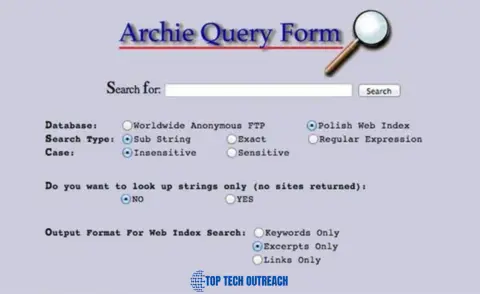
So what was the first search engine? That honor goes to Archie, created in September 1990 by Alan Emtage, a student at McGill University in Montreal. Now, calling Archie a “search engine” by today’s standards is generous; it was more like an automated index for FTP sites. But for its time, Archie was revolutionary.
Here’s how Archie, the first search engine, worked: it would periodically connect to around 150 FTP servers, download their directory listings, and create a searchable index. Users could then search Archie’s database for specific filenames. You couldn’t search the contents of files, just the names. And you definitely couldn’t search web pages because the World Wide Web didn’t exist yet in any meaningful way.
Despite its limitations, Archie solved a real problem. Before Archie came along, finding files meant manually connecting to FTP servers one by one and browsing through directories, hoping to stumble across what you needed. Archie automated that process and made it searchable. The name itself was a play on “archive” without the “v,” though many people mistakenly thought it was named after the comic book character.
Archie’s success inspired similar tools. Veronica (Very Easy Rodent-Oriented Net-wide Index to Computer Archives) launched in 1992, searching Gopher protocol content. Then came Jughead (Jonzy’s Universal Gopher Hierarchy Excavation And Display), because apparently, everyone thought Archie Comics references were hilarious. These tools weren’t true search engines as we know them today, but they laid the conceptual groundwork.
Early Search Engine Names You’ve Probably Forgotten
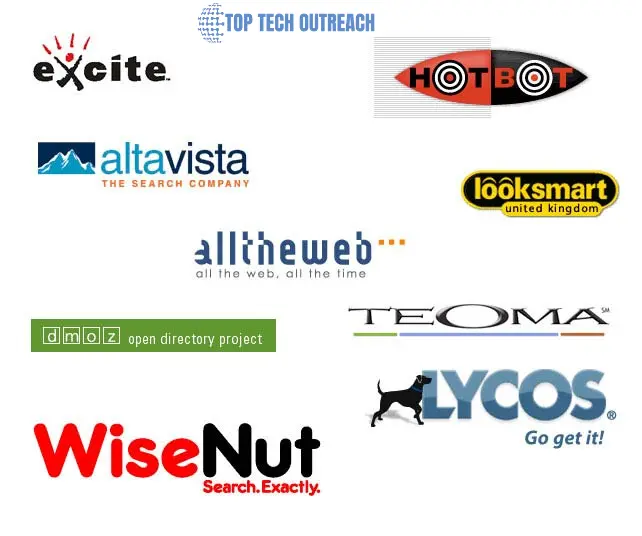
Once the World Wide Web launched in 1991 and started gaining traction, the race was on to build better search tools. The mid-1990s saw an explosion of early search engine names that would eventually fade into obscurity as stronger competitors emerged. Let’s look at some of the pioneers.
W3Catalog and Aliweb (1993)
W3Catalog, created by Oscar Nierstrasz, was one of the first search engines to specifically target the World Wide Web rather than FTP or Gopher. Around the same time, Aliweb (Archie-Like Indexing for the Web) launched with a unique approach—instead of automatically crawling the web, it required webmasters to submit their own index information. This manual submission model would influence later directories like Yahoo.
WebCrawler (1994)
WebCrawler deserves special recognition as the first search engine to index entire web pages rather than just titles and headers. Developed by Brian Pinkerton at the University of Washington, WebCrawler was the first search engine that let you search the full text of documents. This was huge. Suddenly you could find pages based on any word they contained, not just their titles.
WebCrawler was so popular that it regularly crashed from traffic overload. AOL eventually acquired it in 1995, and it bounced around between companies for years before fading away. But in 1994, WebCrawler represented the cutting edge of search engine technology.
Lycos (1994)
Lycos, launched in July 1994 out of Carnegie Mellon University, brought serious innovation to early search engines. It introduced prefix matching (searching for “run” would find “running” and “runner”) and word proximity analysis, helping users find more relevant results. At its peak in 1999, Lycos was one of the most visited destinations on the internet, indexing over 60 million pages.
The Lycos spider mascot became iconic in the late ’90s internet culture. The company expanded aggressively, buying Tripod, Angelfire, and other web properties. But like many dot-com era companies, Lycos overextended itself and eventually sold for a fraction of its peak valuation.
Infoseek (1995)
Infoseek, founded in 1995, was the first search engine to offer paid placement in search results, essentially inventing search advertising before Google perfected it. Infoseek also introduced the ability to submit your website directly to the search engine for indexing, which became standard practice.
What made Infoseek special was its focus on relevancy and natural language queries. You could type questions like “What is the weather in Boston?” rather than just keywords. Disney acquired Infoseek in 1999 and turned it into the Go.com portal, but by 2001, it was essentially defunct.
Excite (1995)
Excite burst onto the scene in 1995 with sophisticated statistical analysis of word relationships. The technology behind Excite came from Stanford University’s research on information retrieval. At one point, Excite was indexing over 50 million web pages and receiving millions of daily searches.
Excite tried to be more than just a search engine it wanted to be a web portal offering news, weather, stock quotes, and personalized content. This portal strategy became common among early search engines, though it ultimately diluted their core search focus.
AltaVista (1995)
AltaVista, launched by Digital Equipment Corporation in December 1995, was a game-changer in search engine history. It was the first search engine to offer comprehensive web coverage with genuinely fast search results. AltaVista indexed tens of millions of pages and could handle millions of queries daily without crashing—revolutionary for the time.
AltaVista introduced advanced search operators that power users loved: Boolean logic, phrase searching, and domain-specific searches. You could search within specific date ranges or file types. For several years in the late 1990s, AltaVista was the most technologically advanced search engine available, and many considered it unbeatable.
So what happened? AltaVista made two fatal mistakes. First, it cluttered its homepage with portal features, diluting its search focus. Second, it underestimated a little startup called Google. By 2003, Yahoo had acquired AltaVista, and by 2013, it was shut down completely. But AltaVista’s innovations in search technology influenced everything that came after.
HotBot (1996)
The 1996 search engine scene was dominated by competition, and HotBot entered with serious backing from Wired magazine. Launched in May 1996, HotBot used the Inktomi search engine technology and quickly became known for speed and comprehensive indexing.
HotBot was the first search engine to offer highly granular search filters—you could search by date, location, media type, and more. It also introduced a clean, fast-loading interface at a time when competitors were cluttering their pages with graphics and portal features. HotBot remained popular through the late ’90s but eventually lost ground to Google and was acquired multiple times before becoming a shell of its former self.
Northern Light (1997)
Northern Light, launched in 1997, brought something unique to search engine history—it organized results into automatically generated topic-based folders. Instead of just showing a ranked list, Northern Light grouped results by subject matter, making it easier to navigate large result sets. It also indexed both the public web and a “Special Collection” of premium content from journals and databases.
While Northern Light never reached the popularity of its competitors, its automatic categorization influenced how later search engines organized information.
The Directory Approach: Yahoo Takes a Different Path
While most companies were building automated search engines, Yahoo took a completely different approach. Founded in January 1994 by Jerry Yang and David Filo at Stanford, Yahoo started as “Jerry and David’s Guide to the World Wide Web”—literally a directory of websites they found interesting, organized into categories.
Yahoo’s directory was maintained manually by human editors who reviewed and categorized websites. This meant Yahoo was more like a library catalog than a search engine. Throughout the mid-to-late 1990s, getting your website listed in Yahoo was the holy grail of online visibility—far more important than ranking in any search engine.
For a while, Yahoo’s approach worked brilliantly. The directory structure made it easy to browse by topic, and human curation meant quality control. Yahoo became the most popular starting point on the web. But the directory model had a fatal flaw: it couldn’t scale. As the web exploded from millions of pages to billions, human editors couldn’t keep up.
Yahoo eventually partnered with various search engines (first AltaVista, then Inktomi, then Google, and finally building its own) to handle queries beyond the directory. But by the time Yahoo fully committed to algorithmic search, Google had already won the war.
The Original Search Engine That Changed Everything: Google’s Rise
Search engine history divides into before Google and after Google. When Larry Page and Sergey Brin launched Google in September 1998, they weren’t the first search engine but they brought a radically different approach.
PageRank: The Algorithm That Changed Search
Google’s secret weapon was PageRank, analyzing the web’s link structure. Instead of just looking at page content, PageRank evaluated how many sites linked to a page and how authoritative those linking sites were. Pages “voted” for other pages through links, with authoritative sites carrying more weight.
This revolutionized search engine history. Previous search engines used mainly on-page factors, keyword frequency, and meta tags, making them easy to manipulate. Google’s approach relied on external validation, much harder to game.
Why Google Won
Google succeeded where early search engines failed for several reasons:
Simplicity: While competitors cluttered homepages with portal features, Google’s page was almost empty, just a logo, search box, and two buttons.
Speed: Google returned results faster through superior infrastructure and efficient algorithms.
Relevance: Google’s results were genuinely better, combining PageRank, content analysis, and continuous refinement.
Innovation: Image search (2001), Google News (2002), Google Scholar (2004), and countless algorithm updates refined quality.
By 2004, “Google” became a verb. “Just Google it” entered everyday language, marking complete cultural dominance.
Search Engines Before Google: The Forgotten Competition
Before Google’s dominance, the search engine landscape was genuinely competitive in 2000. Yahoo had the largest audience with a directory structure. AltaVista offered the most advanced technology. Lycos and Excite were major portals. Ask Jeeves provided natural language queries. MSN Search was being integrated into Microsoft products. Metasearch engines like Dogpile combine multiple search engine results.
Each of these search engines, before Google, had legitimate market share and distinct approaches, driving industry-wide innovation. But one by one, they pivoted away, were acquired, or lost relevance as Google’s superior results attracted more users.
The Algorithm Evolution: From Keywords to AI
Era 1: Keyword Matching (1990-1998) – Early search engines counted keyword frequency and checked meta tags. This led to manipulation through keyword stuffing and invisible text.
Era 2: Link Analysis (1998-2005) – Google’s PageRank made off-page factors crucial, sparking the link-building industry and an arms race between search engines and SEO practitioners.
Era 3: Quality Signals (2005-2012) – Hundreds of ranking factors emerged: domain age, user engagement, page speed, mobile-friendliness. Google Panda (2011) and Penguin (2012) devastated sites gaming the system.
Era 4: Semantic Understanding (2013-2018) – Hummingbird (2013) understood meaning and context, not just keywords. RankBrain (2015) added machine learning, letting Google learn from user behavior.
Era 5: AI and Natural Language (2019-Present) – BERT (2019) and MUM (2021) use natural language processing to understand complex queries across languages and formats, a level that would seem like science fiction to creators of early search engines.
Microsoft’s Search Journey: Bing Emerges
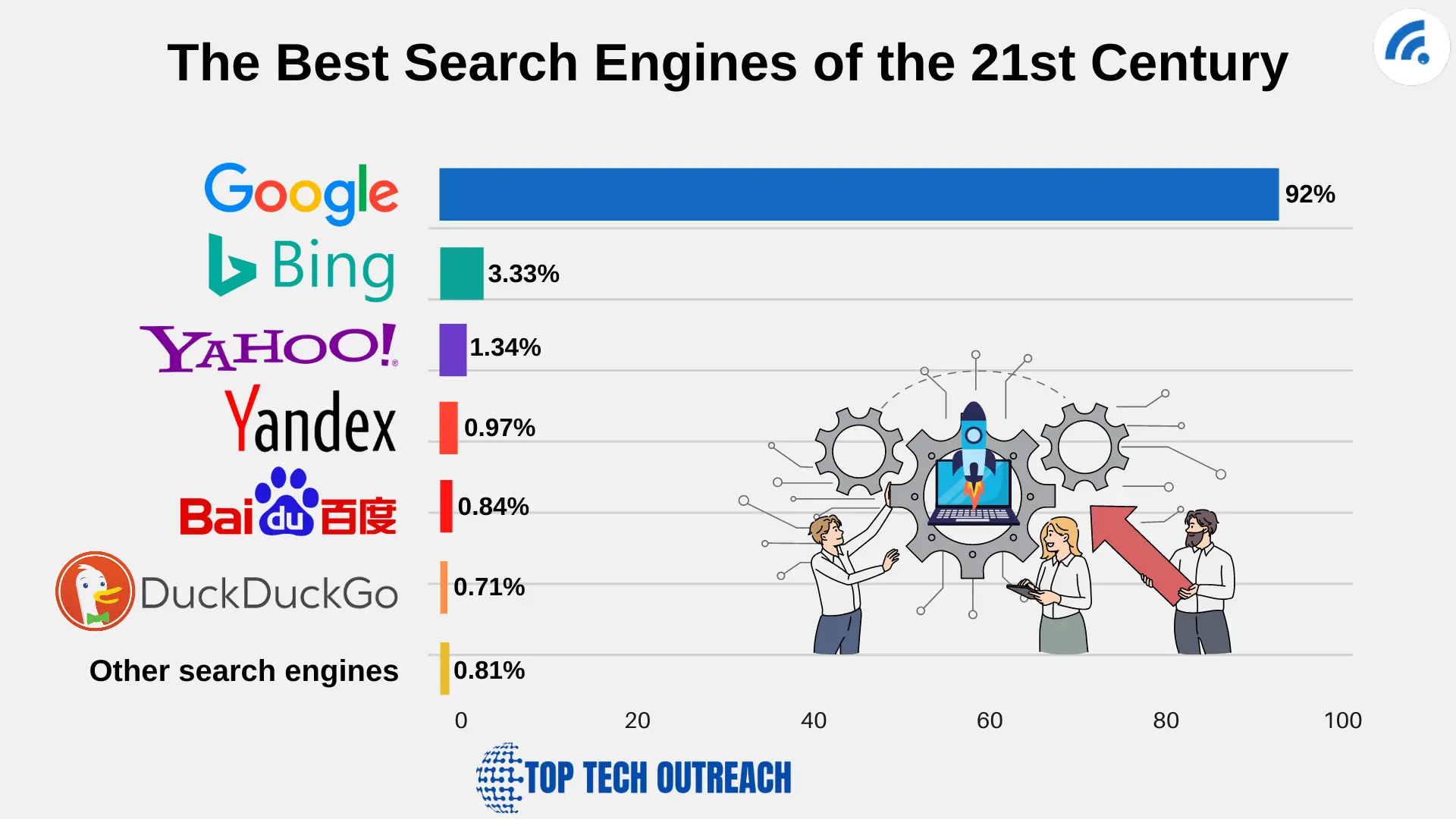
Microsoft launched MSN Search in 1998, then Bing in June 2009 as a serious Google challenger. While never threatening Google’s 90% dominance, Bing became the clear number two search engine, powering Yahoo Search, DuckDuckGo, and Apple’s Siri. Bing Chat with AI integration in 2023 represented Microsoft’s boldest move, challenging how people think about search functionality.
Privacy-Focused Search Engines Emerge
As privacy concerns grew, alternative search engines emerged. DuckDuckGo (2008) became the most successful privacy-focused search engine with the “The search engine that doesn’t track you” tagline, handling over 100 million daily searches by 2022. Brave Search (2021) went further by building an independent index. These alternatives prove that privacy-conscious search engines can succeed despite Google’s dominance.
International Search Engines Challenge Google
While Google dominates globally, search engine history varies by region. Baidu (2000) controls 70% of China’s market. Yandex (1997) dominates Russia with a 60%+ share. Naver maintains a majority market share in South Korea despite Google’s presence. These regional search engines prove that local optimization and cultural understanding can overcome Google’s technical advantages.
Mobile and Voice Search Transform the Landscape
When smartphones arrived in 2007-2008, search engine history entered a new phase. Mobile search introduced smaller screens, local “near me” queries, and voice capabilities. By 2015, mobile searches surpassed desktop searches on Google a massive milestone.
Voice search through Siri (2011), Alexa (2014), and Google Assistant (2016) changed queries from keywords to conversations. Search engines adapted with featured snippets and structured data optimized for voice answers, making “position zero” more valuable than traditional first-page rankings.
AI-Powered Search: The Current Revolution
Starting in 2023, AI integration became the biggest shift in search engine history since PageRank. Microsoft’s Bing Chat (now Copilot) integrated GPT-4, while Google launched Bard (now Gemini) and AI Overviews, generating comprehensive answers directly in results rather than just links.
This raises critical questions: If AI answers directly, will users click websites? How will publishers be compensated? Can traditional SEO survive? These answers remain unclear, but AI represents an inflection point as significant as the original search engines of the 1990s.
What the Future Holds
Several trends will shape the next chapter: multimodal search combining text, images, and voice; the tension between personalization and privacy; specialized vertical search engines for specific domains; and the evolution toward AI answer engines that may not resemble traditional search engines at all.
Frequently Asked Questions About Search Engine History
What was the first search engine ever created?
The first search engine was Archie, created in September 1990 by Alan Emtage at McGill University. Archie indexed FTP sites, making it the original search engine for finding files on the early internet, predating the World Wide Web.
What was the first search engine for the World Wide Web?
W3Catalog and Aliweb, both launched in 1993, were among the first search engines specifically designed for the World Wide Web. However, WebCrawler (1994) was the first search engine to index full web page content rather than just titles.
What were the most popular early search engine names?
The most prominent early search engine names included Archie (1990), WebCrawler (1994), Lycos (1994), Infoseek (1995), AltaVista (1995), Excite (1995), HotBot (1996), Ask Jeeves (1997), and Google (1998).
When was Google created, and why did it succeed?
Google was founded in September 1998 by Larry Page and Sergey Brin. It succeeded because its PageRank algorithm delivered significantly better results than competitors, its interface was simple and fast, and it continually innovated while others stagnated.
What search engines existed before Google?
Before Google dominated, major search engines included Yahoo (directory-based), AltaVista, Lycos, Excite, Infoseek, HotBot, Ask Jeeves, and Northern Light. By the early 2000s, Google’s superior results had displaced most of these competitors.
Is Google the oldest search engine still active?
No. While Google (1998) is the dominant search engine, Yahoo (1994) still operates as a search service, though it now uses Bing’s results rather than its own index. Several other early search engines exist in diminished forms.
What happened to AltaVista and other early search engines?
Most early search engines either failed to innovate, were acquired and shut down, or pivoted to other services. AltaVista was acquired by Yahoo in 2003 and shut down in 2013. Excite and Lycos still exist but are shadows of their former prominence.
How have search engines changed over time?
Search engines evolved from simple keyword matching to sophisticated AI systems. They progressed through link analysis (PageRank), quality signals (content evaluation), semantic understanding (context and intent), and now AI-powered natural language processing.
Final Thoughts: From Archie to Tomorrow
The history of search engines spans just over 30 years, yet it’s difficult to imagine modern life without them. From Archie’s simple FTP index to today’s AI-powered answer engines, the evolution represents one of technology’s most remarkable achievements.
The early search engine names we’ve explored Archie, WebCrawler, Lycos, AltaVista, HotBot might be forgotten by most internet users, but their innovations paved the way for everything that followed. They proved that organizing the internet was possible, even if their methods couldn’t scale indefinitely.
Google’s dominance reshaped not just search but the entire internet economy. The algorithms that determine what billions of people see when they search have profound implications for information access, commerce, media, and society itself.
As we move into the AI era of search, we’re witnessing another fundamental transformation. The search engines of tomorrow might not look like search engines at all, they might be conversational assistants, multimodal AI systems, or something we haven’t yet imagined.
What remains constant is the human need to find information quickly and reliably. Whether you’re searching via text, voice, images, or future interfaces we can’t yet predict, the core challenge endures: helping people discover what they need among billions of possibilities.
The original search engines of the 1990s solved this problem for thousands of pages. Today’s systems handle trillions. Tomorrow will need to do even more, and the next chapter of search engine history is just beginning to be written.