
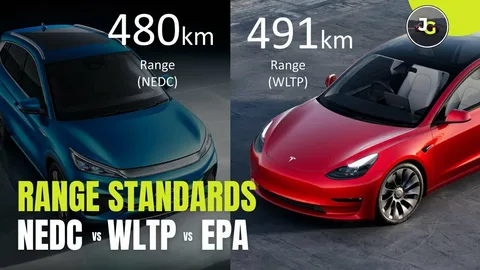
WLTP vs EPA range explained: this guide covers everything you need to know about EV range standards. You are shopping for an electric vehicle. You find the perfect model. Then you notice something strange: the same car is advertised with 300 miles of range in the United States, 340 miles in Europe, and 400 miles in China. Same battery. Same motor. Completely different numbers.
This is not a mistake, and it is not a form of marketing deception. It is the result of three different global testing standards, EPA, WLTP, and NEDC, each measuring the same thing in a completely different way.
If you are buying, comparing, or researching an electric vehicle anywhere in the world, understanding these three standards is not optional. This guide will explain what each one means, how they differ, and most importantly, which number you should trust when deciding how far your EV will go.
What Does WLTP Mean?
WLTP stands for Worldwide Harmonised Light Vehicle Test Procedure. It is the current standard used to measure fuel consumption, CO₂ emissions, and electric vehicle range across the European Union, the United Kingdom, Japan, India, South Korea, and several other markets.
WLTP was introduced in September 2017 for new car models and rolled out to all new registrations in Europe by September 2018. It replaced the older and widely criticized NEDC standard, which had become notorious for producing unrealistically optimistic range figures.
How WLTP Testing Works
The WLTP test cycle is performed in a controlled laboratory environment on a dynamometer, essentially a treadmill for cars. The full test lasts 30 minutes and covers approximately 23.26 kilometers (14.4 miles). It is divided into four driving phases:
• Low speed: Average 18.9 km/h, simulating urban stop-and-go traffic
• Medium speed: Average 39.4 km/h, representing suburban roads
• High speed: Average 56.5 km/h, covering faster road driving
• Extra high speed: Up to 131 km/h, replicating motorway or highway conditions
The test is conducted at a standardized temperature of 23°C (73°F). For electric vehicles specifically, the WLTP considers the impact of optional equipment such as panoramic roofs, larger wheel sizes, and premium audio systems, all of which affect aerodynamic drag and energy consumption. Vehicles are tested in their worst-case configuration to provide a more conservative and honest range estimate.
WLTP Range Accuracy
WLTP figures are generally 10 to 20 percent higher than what most drivers experience in real-world conditions. This gap exists because the test is conducted at a mild, fixed temperature, does not fully account for extreme heat or cold, and follows a structured cycle rather than real-world, unpredictable driving.
Despite this, WLTP is a significant improvement over its predecessor and is now considered the global benchmark for EV range comparison outside of North America.
What Does EPA Mean?
EPA stands for the Environmental Protection Agency, which is the United States federal agency responsible for setting and enforcing vehicle fuel economy standards, emissions limits, and EV range ratings. When you see a range figure on a new electric car sold in the US, that number comes from EPA-mandated testing.
The EPA testing methodology has been refined over several decades and is widely regarded as the most conservative and therefore the most accurate range standard in the world for American driving conditions.
How EPA Testing Works
The EPA uses a multi-cycle testing procedure that goes far beyond what WLTP or NEDC require. The process begins by fully charging the EV battery, then leaving the vehicle overnight. The following day, the car is placed on a dynamometer and subjected to several distinct driving simulations:
- City cycle (UDDS): Stop-and-go urban traffic, average speed 34 km/h, maximum 56 km/h.
- Highway cycle (HWFET): Free-flow highway driving, average speed 77 km/h, maximum 97 km/h.
- High-speed cycle (US06): Aggressive driving up to 129 km/h with rapid acceleration.
- Air conditioning cycle (SC03): Standard driving with full air conditioning running
- Cold temperature cycle: Driving at −7°C (20°F) to simulate winter conditions
Once the testing is complete, the EPA applies an adjustment factor, typically around 0.7, to the raw results. This correction accounts for real-world variables that even the test cycles do not fully capture, such as wind resistance, tire wear, elevation changes, and varying driver behavior. The result is a final EPA-rated range figure that is genuinely close to what most American drivers experience daily.
Why the EPA Range Is Lower Than WLTP
The EPA range for any given electric vehicle is typically 15 to 25 percent lower than the same car’s WLTP figure. This is not because the car performs worse in America; it is because the EPA test is simply more demanding, more comprehensive, and more honest about the range reduction caused by real-world driving habits and conditions in the United States, where highway speeds are higher, and air conditioning use is frequent.
What Does NEDC Mean?
NEDC stands for New European Driving Cycle. Despite the word “new” in its name, NEDC is the oldest of the three standards, developed in the 1970s and last updated in 1997. It remained the official testing standard in Europe until it was formally replaced by WLTP in 2017.
Today, NEDC is considered obsolete for passenger vehicles in most developed markets. However, it is still encountered in documentation for older EVs, some used car listings, and occasionally in the specifications of certain Chinese electric vehicle brands that have not yet completed the transition to WLTP or CLTC (China’s own domestic testing standard).
How NEDC Testing Works
The NEDC test lasts only 20 minutes and covers approximately 11 kilometers. It consists of two phases:
- Urban cycle (ECE-R15): Four identical low-speed segments simulating city driving, with a maximum speed of just 50 km/h and an average speed of 19 km/h
- Extra-urban cycle (EUDC): A single higher-speed segment reaching a maximum of 120 km/h
Crucially, the NEDC test does not activate air conditioning, heating, or any electronic accessories during the test. It does not account for wheel size, optional equipment, or varying temperature conditions. The gear shift points are fixed and gentle, nothing like how most drivers actually drive.
Why NEDC Figures Are Unreliable
Because NEDC was designed in an era before modern EVs existed, it was never built to reflect contemporary driving behavior. The result is range figures that can be 25 to 40 percent higher than what drivers actually achieve in real-world conditions. For electric vehicles specifically, this gap was particularly damaging, as buyers routinely found their car delivered dramatically less range than the official NEDC figure suggested.
This gap between official and real-world range was a significant driver of “range anxiety” in the early EV market, and it is one of the main reasons European regulators introduced WLTP as a replacement.
EPA vs WLTP vs NEDC: Side-by-Side Comparison
The table below summarizes the key differences between all three standards to help you make sense of the numbers at a glance:
| Criteria | EPA | WLTP | NEDC |
| Used In | USA | Europe / Global | Legacy Europe |
| Avg. Speed | ~48 km/h | ~46.5 km/h | ~33 km/h |
| Max Speed | ~97 km/h | ~131 km/h | ~120 km/h |
| Test Duration | Multi-cycle | 30 minutes | 20 minutes |
| Cold Weather | Yes | No | No |
| HVAC Included | Yes | Partial | No |
| Accuracy | Most realistic | Moderate-High | Least realistic |
| vs Real World | ~5% difference | ~10-20% higher | ~25-35% higher |
How to Convert Between EPA, WLTP, and NEDC
When comparing EVs across different markets, you will often need to convert range figures between standards. While no formula is perfectly accurate for every vehicle, these industry-standard approximations provide reliable estimates:
- NEDC to WLTP: Multiply NEDC range by 0.75, for example, 500 km NEDC ≈ , 375 km WLTP
- WLTP to EPA: Multiply WLTP range by 0.84, for example, 400 km WLTP ≈ , 336 km EPA-equivalent
- NEDC to EPA: Multiply NEDC range by 0.63, for example, 500 km NEDC ≈ 315 km EPA-equivalent
For a faster and more precise conversion, you can use a dedicated EV range conversion tool that handles all three standards simultaneously and also converts between kilometers and miles. Convert WLTP, EPA, and NEDC range instantly to get instant results in both kilometres and miles.
Which Range Standard Should You Trust?
The honest answer depends on where you live and how you drive. Here is a practical guide for buyers in different regions:
For US Buyers
Always use the EPA figure. It is the most conservative, the most realistic for American road conditions, and the only figure required by law on vehicles sold in the United States. If a new EV model is announced with only a WLTP figure before its US release, you can estimate the EPA range by multiplying the WLTP figure by approximately 0.84.
For in-depth comparisons of currently available EVs by EPA-rated range, the US Department of Energy’s fueleconomy.gov is the most authoritative and up-to-date resource available.
For UK and European Buyers
Use the WLTP figure as your primary reference. Since WLTP became mandatory for all new vehicle registrations in Europe in 2018, any new car sold in the UK or EU will carry a WLTP rating. Remember that your real-world range will typically be 10 to 20 percent below the WLTP figure, depending on your driving speed, temperature, and use of climate control.
For Buyers of Chinese or Imported EVs
Be especially cautious when you encounter NEDC figures on Chinese EV listings, as some brands, particularly in older model years, still use NEDC as their primary advertised range. Always look for the WLTP figure if one is available, and if only NEDC is provided, apply a 25 to 30 percent reduction to estimate your realistic range.
If the vehicle carries a CLTC (China Light Duty Vehicle Test Cycle) rating instead, apply a similar reduction of around 20 to 30 percent for European conditions and 30 to 35 percent for US-style driving.
For Global Comparison Shopping
If you are comparing EVs from multiple markets and the figures use different standards, always convert everything to the same standard before comparing. WLTP is the most practical common denominator for global comparison it is used in more markets than EPA, and it is far more reliable than NEDC.
Why Your Real-World Range Will Differ From Any Official Rating
Even the most accurate standard, the EPA, is still a laboratory approximation. Real-world range is influenced by a wide range of factors that no standardized test can fully account for:
- Temperature: Cold weather dramatically reduces battery efficiency. Studies show that the range can drop by 20 to 40 percent at temperatures below 0°C (32°F) when cabin heating is running.
- Speed: Aerodynamic drag increases exponentially with speed. Driving at 120 km/h (75 mph) consumes significantly more energy per kilometer than driving at 80 km/h (50 mph).
- Climate control: Running air conditioning or heating places a continuous load on the battery, reducing range, particularly in stop-and-go urban traffic where regenerative braking cannot offset the energy used.
- Driving style: Aggressive acceleration and late braking reduce efficiency. Smooth, anticipatory driving can extend range noticeably beyond the official rating.
- Battery age: Lithium-ion batteries degrade over time. An EV with 80,000 km on the odometer may have 10 to 20 percent less real-world range than a new vehicle of the same model.
- Elevation and terrain: Hilly routes consume more energy on the way up, partially recovered through regenerative braking on the way down, but the recovery is rarely complete.
Understanding these variables allows you to make smarter decisions not just about which EV to buy, but about how to plan routes, when to charge, and how to drive more efficiently. For a practical look at how different electric vehicles stack up in real-world testing beyond official ratings, the EPA’s official vehicle search tool provides verified data across all US-market EVs.
Is WLTP more accurate than NEDC?
Frequently Asked Questions
Yes, significantly. WLTP is a modern, comprehensive test that accounts for real-world driving speeds, optional equipment, and partial climate control loads. NEDC, by contrast, was developed in the 1970s and tested vehicles under idealized laboratory conditions with no accessories running. WLTP figures are typically 15 to 25 percent lower than NEDC for the same vehicle, but they are far more representative of actual driving.
Why does the same EV have different ranges in the US and Europe?
Because the US uses EPA testing and Europe uses WLTP, the same vehicle will always show different official range figures in each market. The testing cycles have different speeds, durations, and correction factors, so the numbers are not directly comparable without conversion. The EPA figure is generally 15 to 25 percent lower than WLTP for the same vehicle.
Which EV range standard is most accurate for real-world driving?
For drivers in the United States, the EPA standard is closest to real-world results. For European and global drivers, WLTP is the most reliable modern standard. NEDC should be treated with significant skepticism and should always be discounted before using it for purchasing decisions.
Do all EV brands use the same testing standard?
No. Tesla uses EPA ratings for US-market vehicles and WLTP for European versions. BYD, MG, and other Chinese brands often show WLTP figures for European models but may still show NEDC or CLTC for domestic Chinese sales. BMW, Mercedes, Hyundai, Kia, and Volkswagen all use WLTP in Europe and EPA in the US.
How do I convert WLTP to miles?
To convert a WLTP range from kilometers to miles, multiply by 0.621. For example, 500 km WLTP equals approximately 311 miles. To then estimate the EPA-equivalent in miles, multiply the WLTP kilometers by 0.84 first, then convert: 500 × 0.84 = 420 km, then 420 × 0.621 = approximately 261 miles EPA-equivalent.
Conclusion
Understanding the difference between EPA, WLTP, and NEDC is one of the most practical things any EV buyer can learn. These three standards exist because the world has not yet agreed on a single universal way to measure electric vehicle range, and until it does, the number on the window sticker will depend entirely on where the car was tested and what methodology was used.
The simple rules to remember are:
- In the United States, trust the EPA figure; it is the most realistic for American driving conditions
- In Europe, the UK, and most global markets, the WLTP figure is the current international standard
- If you encounter an NEDC figure, especially on imported or older EVs, discount it by at least 25 percent before making any decisions
Whether you are buying your first electric car, comparing imported Chinese EVs, or simply trying to understand why the range number changed between the European launch and the American release, knowing these standards puts you in control of the numbers instead of the other way around.
For more EV guides, tech comparisons, and practical buying advice, explore more EV guides and tech comparisons for daily tech news and electric vehicle buying guides.