
Key Takeaway:
SpaceX Starship Flight 9 launched May 27, 2025, achieving the program’s first reused Super Heavy booster and first payload attempt. Still, a propellant leak caused a loss of tank pressure, a spin-out, and an uncontrolled reentry over the Indian Ocean. As of May 2026, SpaceX has flown Flights 10 and 11 and is preparing the redesigned Starship V3 for Flight 12. Flight 9 remains the turning point that revealed the fuel management flaw SpaceX had to solve.
Introduction:
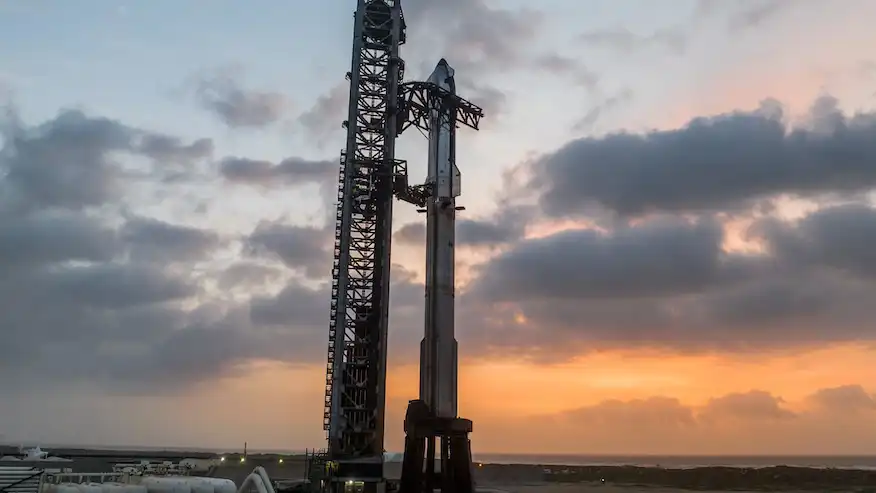
SpaceX Starship Flight 9 was the ninth integrated flight test of SpaceX’s Starship-Super Heavy launch system, lifting off from Starbase in Boca Chica, Texas, on May 27, 2025, at 7:36 PM Eastern. It was the most operationally ambitious Starship test to date, carrying eight Starlink satellite simulators as payload and flying a reused Super Heavy booster for the first time in the program’s history.
The mission reached orbit successfully and achieved scheduled engine cutoff, a genuine milestone over Flights 7 and 8 in January and March 2025, both lost during ascent. However, approximately 20 minutes into the flight, a propellant leak began, causing pressure loss in the main tank. Starship lost attitude control, began spinning, and made an uncontrolled reentry over the Indian Ocean. Super Heavy Booster 14 also exploded shortly after stage separation.
Mission Objectives: What SpaceX Aimed to Prove
Pushing the Boundaries of Reusable Rocketry
By Flight 9, SpaceX had already proven that Starship could launch, separate stages, and have the booster caught by the Mechazilla tower arms. SpaceX designed Flight 9 to go further, proving Starship could actually function as an operational spacecraft: carrying cargo, deploying it, and returning safely. NASA needed to see exactly these capabilities before trusting Starship’s Human Landing System for Artemis crewed lunar missions.
Primary Mission Goals
Flight 9 had four clearly defined test objectives, each more operationally significant than anything the program had attempted before:
- Reuse Super Heavy Booster 14 in flight for the first time, a critical proof point for launch economics
- Open the payload bay door and deploy eight Starlink satellite simulators into orbit, Starship’s very first cargo operation
- Demonstrate improved attitude control during the coast phase and reentry, directly addressing the failure pattern from Flights 7 and 8
- Complete a controlled splashdown in the Indian Ocean, validating the full reentry and descent sequence
Why This Flight Mattered More Than Previous Tests
Engine failures destroyed Flights 7 and 8 during ascent. Flight 9 survived ascent and reached the coast phase, entering territory no previous Starship mission had explored. Starship had never tested orbital coast phase fuel management, in-space payload operations, or controlled reentry before. Flight 9 exposed all three gaps at once. Every failure produced genuinely new engineering data. Much like the greatest technological inventions in history, SpaceX earned each Starship milestone through trial, failure, and iteration, never overnight success.
Launch Day: What Went Right
A Delayed but Successful Liftoff
The countdown on May 27 was briefly halted in its final seconds due to an issue with a quick-disconnect fitting in ground equipment. After resetting to the T-40 second mark, Starship lifted off cleanly. The 33-engine Raptor array on Super Heavy Booster 14, previously flown on Flight 7 and successfully caught by the Mechazilla tower arms, performed nominally, pushing the most powerful rocket system ever constructed off the pad without incident.
Stage Separation and Orbital Insertion
Stage separation proceeded on schedule. Starship Ship 35’s six Raptor vacuum engines ignited and pushed the upper stage into orbit, achieving the scheduled engine cutoff, which Elon Musk specifically called out as a major improvement. Musk also noted no significant heat shield tile loss during ascent.
“Starship made it to the scheduled ship engine cutoff, so big improvement over last flight! Also, no significant loss of heat shield tiles during ascent.” Elon Musk, May 27, 2025
The early flight phases confirmed that the Starship launch stack had become reliable through ascent. Just as today’s most innovative tech products are refined through iterative testing and real-world feedback, Starship’s ascent reliability was earned flight by flight. The new problem territory of the coast phase, payload deployment, and reentry was about to reveal what still needed to be solved.
What Went Wrong: The Technical Failures That Ended the Mission
Propellant Leak and Main Tank Pressure Loss
Approximately 20 minutes into the flight, SpaceX mission control detected a propellant leak developing in the Starship upper stage. The leak caused loss of main tank pressure during the coast and reentry phase confirmed by Elon Musk in his post-flight statement on X. This was the root cause of everything that followed. Without adequate main tank pressure, the vehicle could not maintain propellant delivery to its attitude control thrusters.
Payload Door Failure
Mission control was unable to open the payload bay door during the coast phase, meaning the eight Starlink satellite simulators could not be deployed. This was one of the two primary mission objectives and was lost entirely. The door failure, combined with propellant issues, meant the in-space portion of the mission produced no successful cargo deployment data.
Loss of Attitude Control and Spin
As propellant pressure dropped, Starship lost attitude control and began spinning roughly 20 minutes into the flight. SpaceX’s live broadcast cut away from vehicle camera views for approximately 10 minutes. When the feed resumed around the 30-minute mark, Starship could be seen tumbling in an uncontrolled rotation. Precise three-axis orientation is essential for reentry. The heat shield tiles only protect the vehicle when it approaches belly-first at the correct angle.
Uncontrolled Reentry and Vehicle Loss
Without attitude control and with the heat shield misaligned, Starship disintegrated during atmospheric reentry over the Indian Ocean. The FAA confirmed it was reviewing the anomaly and noted all debris fell within the pre-designated hazard area, an area the FAA had nearly doubled from previous flights after Flights 7 and 8 had sent debris beyond the original hazard zones.
Super Heavy Booster Loss
Super Heavy Booster 14, being reflown after its successful Mechazilla catch on Flight 7, exploded shortly after stage separation rather than completing its planned soft splashdown in the Gulf of Mexico. The FAA determined the booster loss was covered under SpaceX’s pre-approved test-induced damage exceptions and did not require a separate full mishap investigation.
Flight 9 vs. Previous Starship Flights: Understanding the Pattern
Three Consecutive Losses But Different Root Causes
Important distinction: Flights 7 and 8 were lost during ascent due to engine failures. Flight 9 was the first to survive ascent but revealed an entirely new failure mode in the orbital coast phase.
It is critical to distinguish how Flight 9 differed from the two failures before it. Leaders like Stewart from WaveTechGlobal often point out that understanding failure patterns is what separates reactive engineering from proactive innovation, a lesson SpaceX applied directly after Flight 9. Flights 7 and 8 in January and March 2025 both failed within the first 10 minutes during ascent. Flight 9 reached orbit and achieved engine cutoff, a genuine advancement, but then encountered propellant management failure in a regime no previous Starship test had ever reached. This was not the same problem repeating. It was a new problem at a new mission phase.
The Full Flight History in Context
- Flights 1–3: Catastrophic vehicle loss during ascent
- Flight 4: First successful stage separation
- Flight 5: First Mechazilla booster catch
- Flights 6–8: Iterative ascent improvements; both 7 and 8 lost during ascent
- Flight 9: First to reach orbital coast phase, a new failure mode was discovered
- Flights 10–11: Applied fixes; continued progress
- Flight 12 (May 2026): Starship V3 debut from new Pad 2
What Flight 9 Means for SpaceX Going Forward
FAA Investigation and Regulatory Implications
The FAA required SpaceX to conduct a mishap investigation focused on the loss of the Starship upper stage. The investigation requirement added a compliance layer between Flight 9 and the next launch. The FAA’s near-doubling of the aircraft hazard area for Flight 9 following debris dispersion issues in Flights 7 and 8 also signaled growing regulatory scrutiny of the program’s safety margins. Understanding how technology governance shapes outcomes is something our team also explores in depth. Read more on how governance failures slow down even the most advanced tech programs.
Engineering Changes: What SpaceX Fixed
From the vantage point of 2026, the engineering changes SpaceX applied after Flight 9 are clear. The propellant leak and coast-phase pressure loss pointed directly to propellant management and pressurization systems during extended in-space operations, a regime the vehicle had never been tested in before. Flights 10 and 11 incorporated targeted fixes. By Flight 12, the vehicle had been substantially redesigned as Starship V3, with both the booster and upper stage receiving major architectural modifications aimed at enabling full and rapid reuse. This iterative approach to engineering, where each failure becomes a precise diagnostic, mirrors the mindset behind the next wave of technological innovation, reshaping industries in 2026. The organizations that learn fastest from failure are the ones that lead.
Implications for NASA Artemis and the Lunar Mission
NASA’s Artemis program was watching Flight 9 closely. The Human Landing System contract depends on a Starship variant capable of reliably deploying payloads and managing propellant in space. Both the payload door failure and propellant management issue are directly relevant to that mission profile. NASA’s HLS Systems Engineering Manager Tom Percy stated in 2026 that propellant transfer flight demonstrations remain critically important for the multi-launch architecture that deep space exploration requires.
Elon Musk’s Commitment and the Road to Flight 12
After SpaceX Starship Flight 9, Musk confirmed SpaceX intended to accelerate flight cadence, targeting three to four weeks between missions. As of May 2026, SpaceX is preparing to launch Starship Flight 12, the debut of Starship V3, from the new Pad 2 at Starbase. Flight 12 will carry 22 Starlink simulators, including two equipped with cameras to scan Starship’s own heat shield during reentry. Every design decision in V3 reflects lessons learned from Flight 9.
Conclusion:
SpaceX Starship Flight 9 was not the success the space community had hoped for, but viewed from 2026, it was among the most consequential test flights in the program’s history. It was the first Starship mission to reach the orbital coast phase, and in failing there, it revealed the specific propellant management and attitude control problems SpaceX had to solve to move forward.
The FAA investigation, the payload door failure, the propellant leak, and the booster loss each generated engineering data that fed directly into the Starship V3 redesign. SpaceX’s model of rapid iteration accepts hardware loss as the cost of accelerating the learning curve, and Flight 9 is the clearest example of that philosophy producing a necessary, if painful, result.
Flight 9 is not remembered as the flight that failed. It is remembered as the flight that showed SpaceX exactly what still needed to be solved, and they solved it.
FAQs:
When did SpaceX Starship Flight 9 launch?
Flight 9 launched on May 27, 2025, at 7:36 PM Eastern Time from Starbase in Boca Chica, Texas. The countdown was briefly held due to a quick-disconnect fitting issue in ground equipment before liftoff proceeded.
What was the main goal of Starship Flight 9?
The primary goals were to reuse Super Heavy Booster 14 for the first time, deploy eight Starlink satellite simulators from an in-orbit payload bay, demonstrate improved attitude control during coast phase and reentry, and complete a controlled splashdown in the Indian Ocean. None of the reentry or payload objectives were ultimately achieved.
Why did SpaceX Starship Flight 9 fail?
A propellant leak during the orbital coast phase caused loss of main tank pressure. Without adequate propellant pressure, Starship could not maintain attitude control through its reaction control thrusters, causing the vehicle to spin out and make an uncontrolled reentry that destroyed the upper stage over the Indian Ocean.
What did Elon Musk say after Flight 9?
Musk posted on X that “leaks caused loss of main tank pressure during the coast and re-entry phase,” and confirmed, “a lot of good data to review.” He also noted positives: Starship reached the scheduled engine cutoff and showed no significant heat shield tile loss during ascent, both improvements over Flights 7 and 8.
Was this the first time Starship carried a payload?
Yes. Flight 9 was the first integrated Starship flight to carry an actual payload of eight Starlink satellite simulators. However, the payload bay door could not be opened during the flight, so none of the simulators were deployed.
What is the current status of Starship in 2026?
As of May 2026, SpaceX has completed 11 Starship flights. Flight 12, the debut of the substantially redesigned Starship V3, is scheduled for launch no earlier than May 19, 2026, from the new Pad 2 at Starbase. Flight 12 will carry 22 Starlink simulators, with two equipped with cameras to image Starship’s heat shield during reentry.
Does the Flight 9 failure affect NASA’s Artemis program?
Yes. NASA’s Artemis Human Landing System contract depends on Starship reliably deploying payloads and managing propellant in space. Both the payload door failure and propellant management issue from Flight 9 were directly relevant. NASA has stated that propellant transfer demonstration flights remain a critical milestone before the Artemis crewed lunar landing can proceed.
Is SpaceX still committed to Starship after the failures?
Absolutely. As of May 2026, SpaceX has flown corrected systems on Flights 10 and 11 and moved forward to the substantially redesigned Starship V3 for Flight 12. SpaceX’s development philosophy treats vehicle loss as a data-gathering event, a model that has progressively advanced the program from catastrophic early ascent failures to orbital flight, payload operations, and now full-vehicle redesign.